
'All the venues are high-scoring venues. So what you need is pace.' 'You really want someone to come there and control the flow of runs in the death overs, whether you are setting a target or setting a target.' 'It is going to be the fast bowlers because at how many venues have you seen spinners bowling the death overs?'

'At 1.58% of GDP, the defence budget is one of the lowest since the Chinese aggression of 1962.' 'The government of the day has lost sight of the fact that defence of the country is as important as its growth,' says Brigadier S K Chatterji (retd).

The richest one per cent in India now own more than 40 per cent of the country's total wealth, while the bottom half of the population together share just 3 per cent of wealth, a new study showed on Monday. Releasing the India supplement of its annual inequality report on the first day of the World Economic Forum Annual Meeting in Davos, rights group Oxfam International said that taxing India's ten-richest at 5 per cent can fetch entire money to bring children back to school. "A one-off tax on unrealized gains from 2017-2021 on just one billionaire, Gautam Adani, could have raised Rs 1.79 lakh crore, enough to employ more than five million Indian primary school teachers for a year," it added.

'Inter-ministerial coordination, information on the proposed PSUs, and due diligence are taking longer than expected to conclude the process.'

'Starting an SIP now and continuing with it is likely to translate into high returns over the long term.'
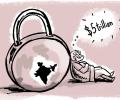
It would be a difficult task for the Indian economy to reach the $5-trillion mark a year before the International Monetary Fund (IMF) projection of 2026-27. Pankaj Chaudhary, minister of state for finance, said in the Rajya Sabha on Tuesday that the government is taking steps to make the country a $5-trillion economy at a date earlier than the IMF's projection. In that context, it would not be difficult to meet the projection in the third quarter of FY27.
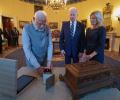
Prime Minister Narendra Modi, who is in the United States for a three-day state visit, has gifted an eco-friendly lab-grown 7.5 carat diamond, placed in Kashmir's exquisite Papier mache box, to First Lady Jill Biden.

Fitch on Tuesday affirmed India's sovereign rating at 'BBB-' with a stable outlook, on robust growth and resilient external finances, but said weak public finances remain a challenge. India's rating has been unchanged at 'BBB-', which is the lowest investment grade, since August 2006. "Fitch Ratings has affirmed India's Long-Term Foreign-Currency Issuer Default Rating (IDR) at 'BBB-' with a Stable Outlook," it said in a statement, adding strong growth potential is a key supporting factor for the sovereign rating.

India has been relatively insulated from the severe headwinds in the West. However, with a third of the global economy expected to slip into recession in calendar year 2023, the impact will strongly be felt on India's exports and trade economy, leading economists said in a panel discussion at the Business Standard BFSI Insight Summit in Mumbai on Wednesday. The panel comprised former Reserve Bank of India executive director and former Monetary Policy Committee member Mridul Saggar, State Bank of India Chief Economic Advisor Soumya Kanti Ghosh, Citibank India Chief Economist Samiran Chakraborty, ICRA Chief Economist Aditi Nayar, and IndusInd Bank Chief Economist Gaurav Kapoor. The topic of the panel discussion was No recession in sight: Is India decoupled from developed economies?

The government has put off by one month the levy of an additional Rs 2 per litre excise duty on petrol and diesel that is not doped with ethanol and bio-diesel in a bid to give the industry more time to implement the measure.

Notwithstanding expectations of a pick-up in construction activity during a seasonally strong January-March quarter (fourth quarter) of 2022-23 (FY23), analysts are cautiously optimistic about the building material sector - encompassing paints, pipes, wood panels, tiles, metals, and cement - as volatile input costs, coupled with fears of a global slowdown, are making demand projections uncertain. Against this backdrop, analysts suggest investors stay selective and pick stocks of companies with stronger brand recall, expanding distribution network, diversified product profile, healthier balance sheet, and sustainable cash flow. "The government's various proposals under Budget 2023-24 (FY24) may lead to the building material segment growing between 8 per cent and 12 per cent for the next five years.

It has been over two decades since the cabinet cleared the BharatNet project, earlier known as National Optical Fibre Network. However, progress of the programme has been slow. While the government had set the target of connecting 100,000 gram panchayats by 2013, it took another four years to achieve this target in December 2017. Progress under the current administration has improved, but the government has again missed its targets.

After bumbling for years since 2014, the Modi government seems to believe that massive government expenditure will lead us to prosperity supported by 'seat-of-the-pants' decision-making, observes Debashis Basu.

Fitch Ratings on Wednesday said India's high fiscal deficit would pose a challenge in lowering the debt to GDP ratio, which is expected to rise above 90 per cent in the next five years. It said India entered the pandemic with little fiscal headroom from a rating perspective. Its general government debt/GDP ratio stood at 72 per cent in 2019, against a median of 42 per cent for 'BBB' rated peers.

The government will conduct a spectrum auction this year, which will facilitate the roll-out of 5G services by private telecom operators during the financial year 2022-23, Finance Minister Nirmala Sitharaman said on Tuesday. "Spectrum auctions will be conducted in 2022 to facilitate the roll-out of 5G mobile services within 2022-23 by private telecom providers," Sitharaman said. She said the telecommunications sector in general and 5G, in particular, can enable growth and offer job opportunities.

Finance Minister Nirmala Sitharaman on Monday announced a Rs 6 lakh crore National Monetisation Pipeline (NMP) that will look to unlock value in infrastructure assets across sectors ranging from power to road and railways. She also said the asset monetisation does not involve selling of land and it is about monetising brownfield assets. Projects have been identified across sectors, with roads, railways and power being the top segments.

While she primed up spending on infrastructure to create jobs and boost economic activity, Sitharaman did not tinker with income tax slabs or tax rates. Her Budget for the fiscal year beginning April 2022 proposed a massive 35 per cent jump in capital expenditure to Rs 7.5 lakh crore, coupled with rationalisation of customs duty, an extension of time for setting up new manufacturing companies and plans for starting a digital currency and tax crypto assets.

'Or because I am getting a s**tload of money.'

'The signal is crude oil prices will rise, I am cutting my subsidy. Be prepared, prices will rise.'

Finance Minister Nirmala Sitharaman on Monday said the government estimates fiscal deficit of 6.8 per cent of the gross domestic product (GDP) in the next financial year beginning April 1. However, the fiscal deficit in 2020-21 is estimated to soar up to 9.5 per cent due to rise in expenditure on account of the outbreak of COVID-19 and moderation in revenue during this fiscal year.

Moody's Investors Service, while silent on the sovereign rating on the higher-than-expected fiscal deficit numbers, expressed doubts over attaining the higher revenue targets and divestment realisation as assumed in the Budget. The Union Budget 2021-22 has pegged a fiscal deficit of 9.5 per cent for the current financial year as against the consensus 7 per cent, and 6.8 per cent for 2021-22 with a market borrowing of around Rs 12 lakh crore. It also assumes Rs 1.75 lakh crore to be scooped up from divestment.

Sectors throw up a wishlist for the Finance Minister.

It offers a real opportunity for the flag carrier to compete on the world stage, backed by a leading conglomerate with deep pockets like the Tatas, observes Indrajit Gupta.

Finance Minister Pranab Mukherjee's decision to co-contribute, for 3 years, Rs 1,000 per annum to each individual who opens an account under the New Pension Scheme is more than welcome.

'The skilling gap is a serious issue.' 'We partner with the government on skilling, but as a company we have several skilling programmes, and we work closely with the partner ecosystem.
Fitch Ratings on Friday said it has revised the outlook on India's sovereign rating to 'stable' from 'negative' as downside risks to medium-term growth have diminished on rapid economic recovery. Fitch Ratings kept the rating unchanged at 'BBB-'.

Banning the import of platforms that are already being built in India serves little purpose.

Alfa Romeo announced Guanyu Zhou as China's first Formula One racing driver on Tuesday with his arrival in 2022 hailed by both the team and the sport as a historic breakthrough in a key growth market.

Amid protest over the proposed ambitious semi-highspeed SilverLine rail project, also known as K-Rail, the Kerala government on Saturday published the detailed project report that estimated the cost of project to be Rs 63,941 crore.

Here's what could be ahead for India: A $10-trillion economy by 2030-32, a Sensex at 1,00,000 by 2025, monthly GST revenues at Rs 2 trillion by 2024-25, 100 new unicorns by 2025, and poverty below 5 per cent by 2030, predicts R Jagannathan.

It is learnt that the Chinese JF-17 was cheaper but could not match the technical parameters of the Tejas Mk-IA variant and the offer of maintenance of the Su-30 fleet as proposed by India.

Foreign portfolio investors (FPIs) remained net buyers to the tune of Rs 12,266 crore in the Indian market in the first five trading sessions of February, as positive sentiment post-Union Budget 2021 sparked a rally in investment.

The government on Wednesday said it will borrow Rs 7.24 lakh crore in the first half of 2021-22 fiscal to meet resources to perk up the economy hit by the coronavirus pandemic. According to the Budget 2021-22, the government's gross borrowing was estimated at Rs 12.05 lakh crore in the financial year beginning April 1. "In the Budget, we had announced that there would be a gross borrowing of Rs 12.05 lakh crore and net borrowing of Rs 9.37 lakh crore. "In the first half of 2021-22, we would be borrowing Rs 7.24 lakh crore, which is 60.06 per cent of the gross issuances," economic affairs secretary Tarun Bajaj said. He said the government would issue 2-year, 5-year, 10-year, 14-year, 30-year, and 40-year securities.

The Union cabinet on Wednesday approved the roll-out of the 'PM POSHAN in Schools' scheme that will provide hot cooked meal to students of elementary classes in government and government-aided schools across the country.

Unveiling his infrastructure conglomerate's green vision, billionaire Gautam Adani on Tuesday said his group will invest $20 billion over the next 10 years in renewable energy generation and component manufacturing and will produce the world's cheapest green electron. The port-to-energy conglomerate plans to triple its renewable power generation capacity over the next four years, foray into green hydrogen production, power all data centres with renewable energy, turn its ports into net carbon zero by 2025, and plans to spend over 75 per cent of capital expenditure until 2025 in green technologies, he said. Speaking at JP Morgan India Investor Summit, Adani Group chairman said the USD 20 billion investment will be in renewable energy generation, component manufacturing, transmission and distribution.

From cloud computing to people analytics, most lucrative future jobs will be dominated by people with digital skills and expertise, explains Sarita Digumarti, chief learning officer, UNext Learning.

'Movie-goers will thrive if you give them what they want.'
The wait for India to become a $5-trillion economic powerhouse by 2024-25 (FY25) is going to take longer than what the finance ministry had originally intended, according to the International Monetary Fund (IMF). The vision will instead be achieved in 2028-29 (FY29), reveals the IMF data, illustrating a four-year delay. Chief Economic Advisor (CEA) V Anantha Nageswaran had in February said India would become a $5-trillion economy by 2025-26 or the following year, on the back of 8-9 per cent sustained growth rate in real gross domestic product (GDP). However, the IMF data conveys that the economy will be $4.92 trillion in FY28, clearly alluding to the fact that the target will be realised in FY29.

By 2025, natural gas will comprise 20% of the Indian primary energy basket. Natural gas will substitute crude oil for a host of applications due to its non-polluting and economic nature.

Speaking after interacting with gram panchayats and pani samitis/village water and sanitation committees (VWSC) on the Jal Jeevan Mission, Modi said the mission is not just about bringing water to people but it is also a decentralisation movement that is village and women-driven.
 © 2026 Rediff.com - Advertise with us - Disclaimer - Privacy Policy - Sitemap - Feedback - About us - Terms of use - Grievances